
The Curve Rises With AI: +25% at Walmart

This edition’s article comes from our ever-fabulous Ebeltoft partners at Retail Institute Scandinavia A/S – and not only clever and funny but the most fashionable of all the Ebbers. Dorte Wimmer and Line Kluge Albert digs into how artificial intelligence is no longer a retail experiment – it is becoming the engine of the entire customer journey. From Walmart’s AI-powered in-store tools to Instacart’s mission to bring the same technology to grocery chains of every size, they map out what is driving the shift, what the numbers say, and what it means for the sector.
They have also added some APAC context – because this story is not just happening in North America. Instacart’s Caper Carts have already arrived on our doorstep, with Coles Supermarkets in Melbourne becoming the first retailer in Asia Pacific to deploy the technology. A good reminder that the future of retail rarely waits for permission before it lands.
The Curve Rises With AI: +25% at Walmart
– study shows global consumers are ready too
Walmart and Instacart demonstrate how artificial intelligence can elevate both the customer experience and operational performance in retail. At the same time, Danish consumers are more ready than ever. More than one-third already use AI in relation to shopping - a 46% increase since last year.

When Walmart enables customers to find products, plan parties, and navigate the store using artificial intelligence - and when Instacart launches AI solutions designed to make the technology accessible to grocery chains of all sizes - it’s not just American experiments. It reflects a global movement in which AI is becoming a natural part of the customer journey.
Walmart as a benchmark for the future in-store experience The world’s largest retailer has just rolled out five new AI features in its app - tailored to each individual store and activated the moment a customer walks through the door. The tools are designed to make shopping both faster and more inspiring.
First, Walmart introduces an in-store savings tool that consolidates all local offers, price reductions, and Black Friday promotions in one place, allowing customers to easily see where they can save the most.
Second, the app gets an enhanced search and navigation function, allowing customers to search for products as they would online - and immediately see exactly where on the shelf they are located.
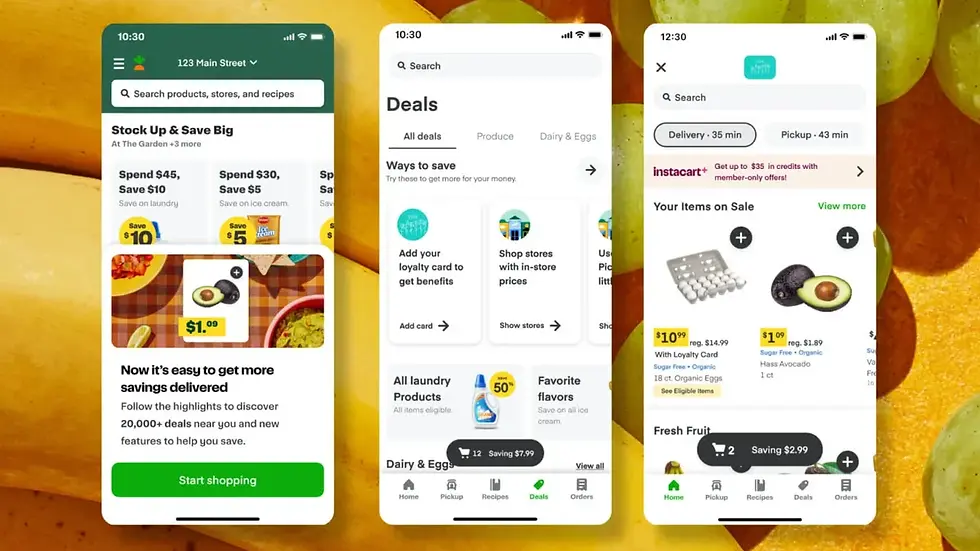
Third, a wishlist feature is added, automatically sorting products by aisle so the shopping trip becomes quicker and more manageable.
Fourth, customers can get help from the AI assistant Sparky, which now acts as a party planner and creates complete shopping lists for any occasion - from confetti to champagne. Check it out in action here.

Fifth, Walmart launches AI-generated audio summaries, condensing product descriptions and reviews into short audio clips so customers on the go can listen their way to the right choice.
Additionally, Walmart enhances the customer experience with AI-powered 3D visualization through Dynamic Showroom and Shop the Background. Here, customers can step into virtual environments, swap furniture, colours, and decorations, and add everything directly to their cart. At the same time, AI agents help optimize everything from delivery and inventory flow to freshness and maintenance, ensuring smooth operations even in peak periods.
According to Walmart U.S., customers who actively use the app during shopping spend on average 25% more than those who don’t.
“The most wonderful time of the year should be a joyful experience, and with AI and technology, we make that possible,” says Tracy Poulliot, Senior VP of Shopping Experiences at Walmart.
She emphasises that the new features are not only meant for the holiday season but should elevate everyday shopping throughout the year.
Walmart has since moved even further and faster. In October 2025, the retailer enabled customers to purchase products directly within ChatGPT using OpenAI’s Instant Checkout feature – one of the first major retailers to do so.
Then in January 2026, Walmart and Google announced a new integration pairing Google’s Gemini AI assistant with Walmart and Sam’s Club’s product range, allowing shoppers to discover and buy products through conversational AI. “The transition from traditional web or app search to agent-led commerce represents the next great evolution in retail,” said incoming Walmart CEO John Furner at the announcement. Together, these moves signal that Walmart is no longer just embedding AI in its own app – it is placing itself at the centre of wherever AI-powered shopping happens.

Instacart brings AI to grocery retailers
While Walmart develops its own technological infrastructure, Instacart focuses on democratising AI for the entire grocery sector. In November 2025, the company launched AI Solutions - an enterprise suite designed to help chains of all sizes create smarter, more personalised customer experiences.
“AI is transforming the way people shop and plan meals, and Instacart is uniquely positioned to help both large chains and local stores leverage the technology,” says Chris Rogers, CEO of Instacart.
Instacart’s AI Solutions focus on five key areas:
Cart Assistant: a digital shopping assistant combining personalized meal planning, product recommendations, and budget management — both online and in-store via Instacart’s AI-powered Caper Carts.
Store View: an AI system using images and video to provide real-time insights into shelf conditions and inventory.
Catalog Engine: using vision-language models to extract billions of data points on ingredients, nutrition, and allergens for more accurate search and recommendations.
Agentic Analytics: enabling retailers to ask complex questions (e.g., which campaigns perform best) and receive answers within seconds.
Agentic Commerce: connecting Instacart’s network of 2,200 retail partners with AI collaborations from companies like OpenAI, Google, and Microsoft.
Sprouts Farmers Market and Kroger are among the first to implement the solutions.
Since launch, Cart Assistant has expanded well beyond these early partners. By early 2026, Food Bazaar, Heritage Grocers, Restaurant Depot, The Save Mart Companies, and Woodman’s had all joined the programme – a signal that AI-powered shopping assistance is moving quickly from pilot to mainstream across the grocery sector.
“AI is changing the way people shop. Customers want an experience that feels more personal and intuitive,” says Nick Konat, President and COO of Sprouts Farmers Market.
That democratisation is already reaching beyond North America. In February 2025, Coles Supermarkets in Australia became the first retailer in the Asia Pacific region to deploy Caper Carts – Instacart’s AI-powered smart trolleys. Equipped with cameras, AI, and a built-in scale, the trolleys automatically recognise items as they are added, let customers bag as they shop, and allow checkout directly from the cart. It is the online shopping experience, brought to the shop floor.

Global consumers embrace AI
An international consumer study shows that around 35 % of consumers now use AI for shopping, a 46 % increase since 2024.
Generation Z leads the way. A full 56% of 16–27-year-olds use AI in their shopping process, while Generation X (44–59 years) shows the highest growth at 54%.
AI is primarily used as an inspiration tool.
49% of AI shoppers say the technology inspires them to discover new clothes, meals, and products, while 45% use it to find unique brands.
For many, AI acts as a digital shopping companion, connecting personalisation with discovery.
When AI becomes retail’s most important employee
At both Walmart and Instacart, AI already acts as a digital employee, assisting customers, streamlining operations, and extending the customer journey. The potential goes far beyond navigation and discounts — artificial intelligence is moving from tool to operational partner.
More retail companies plan to invest in AI for sales enablement, marketing, and product development. This signals a sector where AI is no longer about experimentation but about strategic business and the bottom line.
In other words: artificial intelligence is no longer a supplement in retail, it is the driver of the next growth phase.
From omnichannel to AI-channel
Although consumers quickly adopt new technology, data shows that only just over half of the retail sector offers a seamless experience across channels. The initiatives from Walmart and Instacart show how AI can bridge the final gaps and make the customer experience both seamless and personal.
As customers increasingly expect their digital shopping assistant to follow them from mobile to store shelf, AI becomes more than a marketing tool - it becomes the backbone of the future customer journey.
And with 42% of consumers still preferring to shop in physical stores, AI becomes the factor that can make the in-store experience as personalised, efficient, and inspiring as online.
3 things to take with you
AI creates more than efficiency - it creates experience. Walmart shows how AI can transform the shop floor into a personal universe where inspiration, offers, and guidance merge.
AI becomes accessible to everyone. Instacart demonstrates that AI is no longer only for the biggest players — the technology can now be implemented by both local and national chains.
AI becomes the key to a new form of retail. The winners of the coming years will be those who integrate AI across channels - not just to sell smarter, but to build stronger, more relevant relationships with customers.
AI as a competitive advantage
Walmart and Instacart show how AI can turn data into real value - not just digitally, but right in the store aisles. Global consumers are already ready, and competitors are starting to move.
When both the 22-year-old Gen Z shopper and the 50-year-old Gen X customer use AI as a natural part of their shopping, it is time to think of artificial intelligence as more than future technology.
AI has become retail’s most important - and most personal - employee.
Sources:
Walmart Announces New Holiday Shopping Experiences (Walmart, 31. oktober 2025)
Instacart Announces New Enterprise AI Solutions to Democratize AI for Grocers of All Sizes (Instacart, 4. november 2025)

INFO BOXES
Who is Walmart?
Walmart is the world’s largest retailer by revenue, with over 10,750 stores in 19 countries and around 270 million customers every week. The company employs more than 2.1 million people globally and generated USD 681 billion in revenue in 2025. Walmart is known as one of the world’s most data-driven retail organisations. The chain invests heavily in artificial intelligence, automation, and predictive logistics - from AI-powered product recommendations to real-time management of deliveries, inventory, and customer service.
Who is Instacart?
Instacart is North America’s leading grocery tech company and the technology partner for more than 2200 grocery retailers - from large national chains like Kroger to smaller independents. The company connects customers with over 100,000 stores in the U.S. and Canada and collaborates with roughly 600,000 shoppers who deliver groceries directly to consumers’ doorsteps. In addition to its delivery platform, Instacart Marketplace, the company operates The Instacart Platform, providing technology solutions to the entire sector - including e-commerce, inventory management, and marketing tools.
Comments